Buyers of expensive wireless headphones often scrutinize the box for advanced Bluetooth codecs. It's a tempting virtue signal, suggesting a step up from standard Bluetooth audio. But like much on a spec sheet, codec support is not enough by itself.
Codec support is negotiated, not advertised
Bluetooth audio packets are compressed from the device to the headphones. The bitrate is directly tied to the radio signal quality.
The device and headphones both declare which codecs they support. The device gets to choose, and the codec used depends on the supported codecs, current link conditions [and quality of service?] and user and application preferences. During playback, it's possible that different audio samples use different codecs.
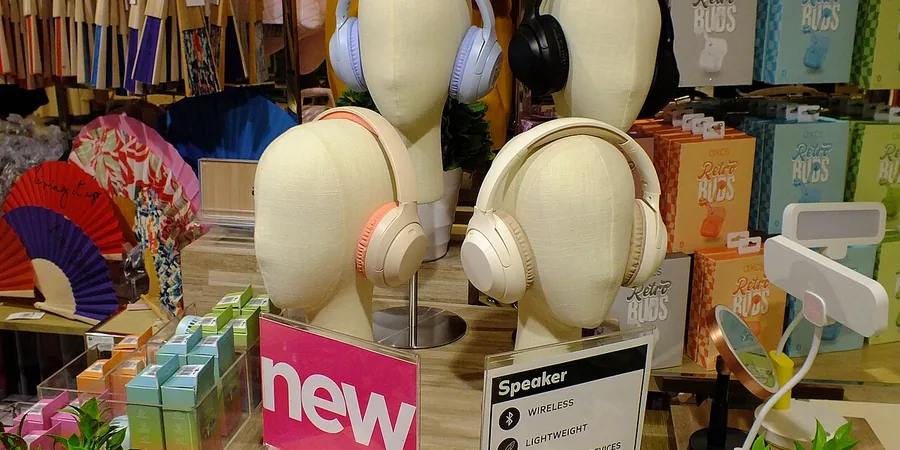
The headphones' spec sheet advertises what codecs they can accept, but not what codec they will receive. Headphones can be lateral and vertical economic upgrades; the display advertises the better codec, and the buyer is fooled by the showing of supported codecs. The headphone's showable nature is a facet of performance marketing, glossing over that the device is the controller of choice.
If the codec used decreases over time, it is typically because of reduced link stability. In practice, under some conditions, an advanced codec offers degraded playback; on others it reduces stability vs. battery for small audio quality gains.
The device, not the headphone, usually decides the active codec. Old advice used to suggest the headphones were the client.
The idea that having an appliance offering more advanced codecs vs. a baseline codec will deliver better attenuation is still promoted. But it is akin to listing the supported resolutions for a new smart TV and game console; people don't perceive those large changes. As Sony promotes LDAC, focusing on. Thus, how many codecs an appliance supports is immaterial to quality perception.
The best anecdote is to verify the active codec during playback; Active Codec can be checked in Android's Developer Options or on connected Macs in the Bluetooth panel.
LDAC: higher bitrate, more fragility
LDAC is an open codec, initially adopted by Sony. Android has supported it since version 8.
LDAC is exceptional for supporting very high bitrates. Compared to aptX HD, it streams at on the highest quality setting.
The codec's biggest issue is how easily the link degrades. LDAC has a large advantage at over SBC at.
For multitaskers, it's important to remember that higher bitrates will result in higher battery usage, battery usage contributing to link condition.
Another issue, putatively, is a ceiling. If the environment keeps the one device close but the other way, the delivery might become the bottleneck. Even on long distances, performance might diminish.
There is a theory that the lossy nature of codecs like LDAC cause them to diminish connection and latency advantages.
Sony has been a big evangelist of the codec. They even offer LDAC tunes in the Playstation app. They are still largely the only ones with an entire library in the codec. On the other hand, the codec's efficiency may only apply to high quality sources like FLAC..
LDAC faces issues playing media in iOS. Apple has focused on AAC for iOS.
What matters for buyers
It's a hard question to answer what a buyer should lean on regarding Bluetooth codecs. The ability for codecs to deliver on their marketed feature sets is much more important than the sheer number of possible codecs, a single variant.
Android phones support a wide swath of codecs. Codecs and audio in general are a big set of features. With such a competitive market, any drop by one company in codecs leads to a leap by another. On the other hand, Active Codecs are unbounded by design.
Thus, not only is codec performance undependable between two devices, but it may disappear before the device hits used territory.
[journey of discovery writing coming out of this, but they didn't ask for it. The value is in the novelty of revelation.]
Android supports a variety of codecs, differing from iOS. Apple, on the other hand, is throttled by their choice to deeply integrate their codecs in their main platforms, iOS and macOS, and not extending them to Android would be a loss.
[sorting other factual claims about codec prevalence by device tracking stats]
Until now, processors have suffered from little diversity as a bottleneck. The high cost of LC3 and little latency/codec tradeoff make it hard to think of sophisticated codecs as swappable. By choosing more simple specs like frequency response, high-resolution and noise cancellation, a buyer can remove the uncertain codec equation.