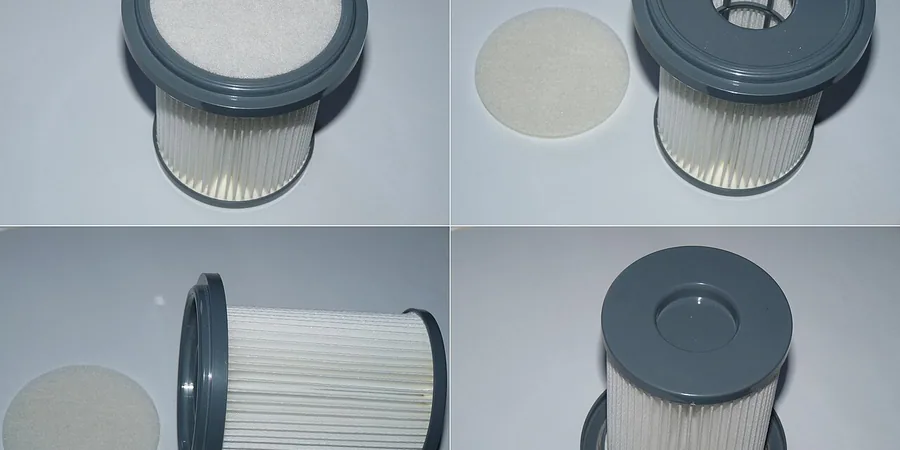
The label “HEPA” looks like a claim you can count on — until you also see “HEPA-type” and “H13” elsewhere on the shelf.
Like other official-sounding labels, HEPA has two separate meanings: an efficiency standard in the U.S. and a different grading scheme in Europe. Without regulating either use, manufacturers can easily describe their products as “HEPA” or more vaguely as “HEPA-type” even if they fail the actual tests.
What HEPA Actually Means
According to the U.S. Environmental Protection Agency, a genuine HEPA filter can theoretically collect at least 99.97% of dust, pollen, mold, bacteria, and airborne particles sized at 0.3 microns (µm). HEPA itself is not a single product, but a standard backed by that 99.97% efficiency claim at the 0.3-micron "worst case" point. The EPA page explicitly lists smoke, pollen, mold, bacteria, and airborne particles as examples of what a HEPA filter targets.
The EPA’s HEPA guidance emphasizes that a certified HEPA filter’s efficiency rises for particles smaller than 0.3 µm — meaning 0.3µm is the filter's benchmarking point, not a cutoff size. A HEPA filter moving 1,000 cubic feet of air per minute, for example, will remove many more particles than a standard filter.
The US standard limits air-leaks, meaning a total-efficiency claim — HEPA — needs a seal. A comparison figure like the Clean Air Delivery Rate values air exchange for a particle type, but without evidence of how much air bypasses the filter. Replacement frequency standards seem to be manufacturer-specific, though manufacturers refer to AHAM program guides. AHAM lists criteria including room size vs. air volume (e.g., using CADR), but not replacement intervals or testing back-up airtightness.
Why H13 Is Not the Same Label
The European classification uses EN 1822 with a set of finer-grained efficiency classes than the U.S. HEPA label. EN 1822 includes "H10" to "H14" classifications, with "H13" defined as at least 99.95% filtration of particles at the "most penetrating particle size" (MPPS; the hardest-to-capture size for the filter). The MPPS is likely to be closer to 0.1 to 0.2 µm than to 0.3 µm, but the claim does not address hard particle capture at the MPPS point, the most efficient capture size.
It’s not clear there is an official definition of "HEPA" in Europe: [](https://www.iso29463.com/) as a guidance document that "does not constitute a standard." This Blueair explainer summarizes U.S. EPA guidance as well as AHAM standards for room size, flow rate, and certification, but does not explain the CPSC rules that "HEPA" claims.
One indication that your HEPA filter is the real deal: that it has been independently verified. AHAM Verifide that third-party testing program tests CADR and makes room-size claims. AHAM Verifide lists features like CADR and a common 1.55 sq. ft. room-estimation shortcut, but does not seem to test seal quality or make replacement claims.
What the Extra Features Do and Don’t Do
Ionizers are meant to improve a filter’s effectiveness by electrically charging particles or the filter itself, but the extra costs are associated with ozone production though the ozone theory is less clear. Many boxes carrying an ionizer setting can increase ozone output from a purifier, but there is a lack of official warnings. High ozone levels can be a health risk](https://www.fda.gov/consumers/consumer-updates/how-find-best-air-purifier-your-home#:~:text=Avoid%20units%20that%20generate%20ozone,%,does%20emit%20ozone.)
"Activated carbon" in the filter’s name suggests it will remove odor and gasses, not particles. Activated carbon treatment may remove particles, but the HEPA claim stands or falls on its filtration. Activated carbon appears widely in explanations of odors and gaseous impurities, but there is no direct source on certified standards.
How to Spot Marketing Language
Though “HEPA” is a recognized standard, labels like “HEPA-type” or “99% HEPA” do not necessarily meet the EPA or European standards. Buyers need to check for third-party testing and documentation for the boxed filter. To qualify under EU rules, the filter needs a standard, test condition, and particle-size basis on the package.
How to Read Replacement Claims
A HEPA filter box or setting may show replacement schedule, but the timing depends heavily on usage, not just months. The replacement depends on airflow, load, and environmental factors, though there do not seem to be primary-source rules.
The final word rests on how to tell marketing language from standard-promises. With a standard-backed claim, the box will name a certification, test basis, CADR, and air-tightness. Without that level of detail, the shopper is interacting with a general product label that may not stand up to scrutiny.